31 Architectural Curves Bathroom Modern Design Ideas

Architectural curves bathroom modern design brings a sophisticated fluidity to contemporary homes that once relied solely on sharp angles and straight lines.
The gentle sweep of a rounded vanity or the organic contour of a freestanding tub can soften even the most minimalist spaces while maintaining that sleek aesthetic you love in modern interiors.
Curves introduce movement and visual interest without overwhelming a room, making bathrooms feel more inviting and less clinical than their strictly geometric counterparts.
Many homeowners now embrace this balance between structured design and softer forms, recognizing how curved elements can enhance both function and beauty in wet spaces.
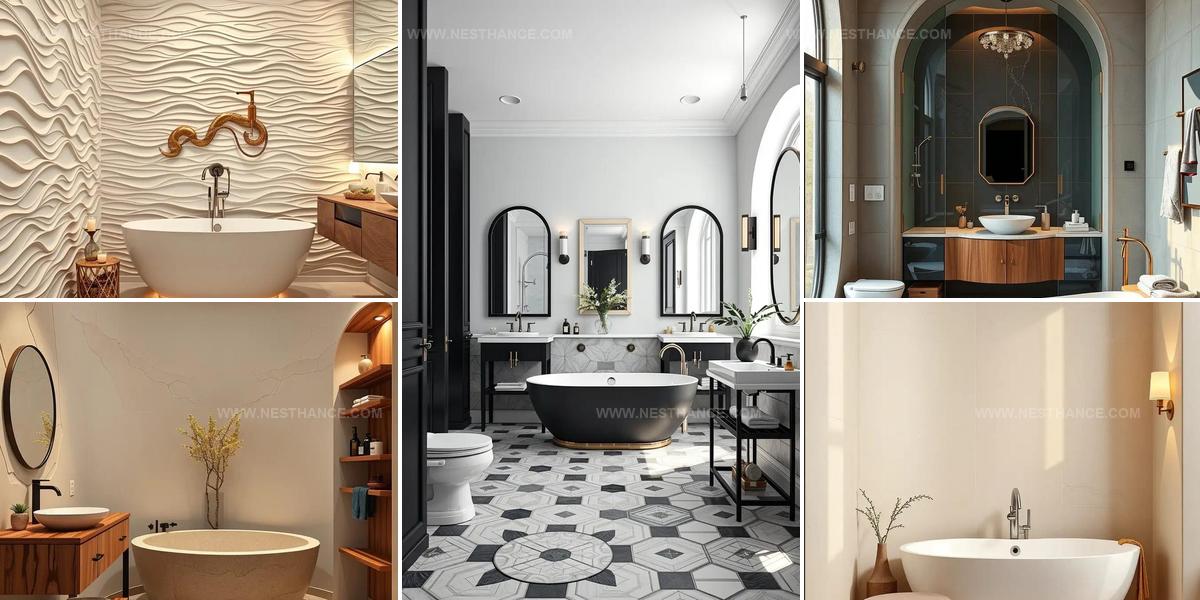
From arched doorways to wave-like tile patterns, the integration of gentle shapes continues to gain momentum in bathroom renovations across the globe.
The approach works particularly well in smaller bathrooms where harsh corners can make spaces feel cramped and unwelcoming.
Learning how to incorporate these flowing elements successfully can help anyone refresh their bathroom into a space that feels both current and timeless.
Stone Resin Curves Transform Bathrooms
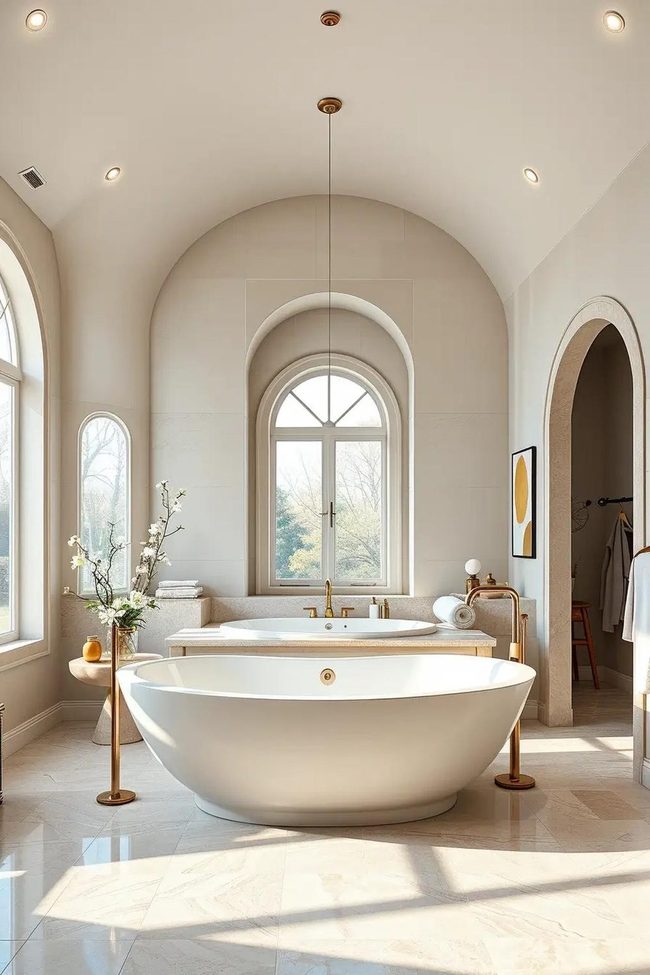
Sculptural bathtubs stand out as one of the most striking architectural features you can place in a bathroom, and they function as far more than just a place to wash.
Made from materials like stone resin, acrylic, or marble composite, these tubs become the room's main focal point with their beautiful curves and organic shapes.
Positioning them on a raised platform or beneath a skydaylit amplifies their presence and draws attention to their sculptural forms.
You can enhance the look by pairing these tubs with curved towel racks, round bathmats, and arched windows that echo their rounded lines.
Beyond aesthetics, homes featuring statement bathtubs often see improved resale values because they add such personality to the space.
To make the design feel connected, match your tub with other curved elements in the room, such as rounded walls or lit alcoves.
People love how these pieces combine both drama and comfort, giving a bathroom a sense of luxury that feels both refined and livable.
Whether you choose pebble-inspired rims or asymmetrical edges, a sculptural tub reshapes your entire bathroom into a curated space that feels intentional and complete.
Curved Bathroom Edges Everywhere
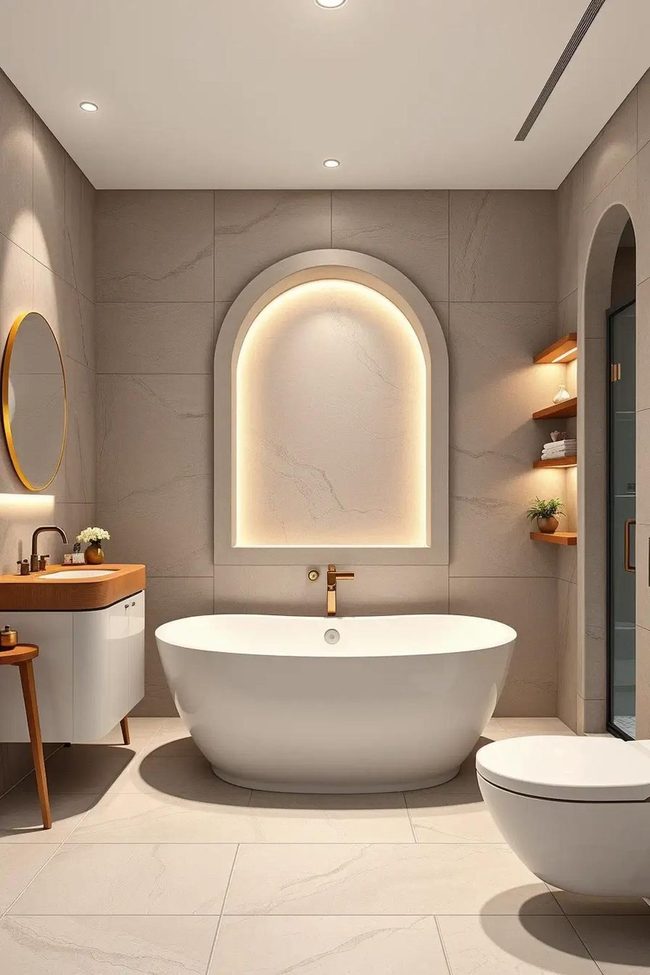
Rounded corners and curved edges throughout a bathroom form a striking visual shift that you are able to pick up on immediately when you walk in.
Curves guide your eye smoothly across the space instead of stopping at hard angles and straight lines, making the room feel naturally flowing and pleasant.
Consider swapping out your standard boxy vanity for one with rounded drawer fronts or an oval integrated sink, adding a freestanding bathtub with tapered sides, or installing arched shower niches lined with bullnose tiles that eliminate harsh trim lines.
Floating shelves with rounded edges and materials like polished concrete, plaster, or microcement work beautifully in these designs and feel organic to the space.
Beyond aesthetics, we know that rounded edges keep families and elderly household members safer while maintaining a timeless, classic look that appears calm and functional at the same time.
Curved ceilings or barrel vaults can elevate a small bathroom dramatically, and pairing them with recessed dayliting or skydaylits keeps the vertical dimension from feeling too overwhelming.
Research into these curved ceiling options opens up new possibilities for your space.
By using this layout, brings together safety, style, and visual comfort in one simple design choice.
Curved Lines Calm Small Bathrooms
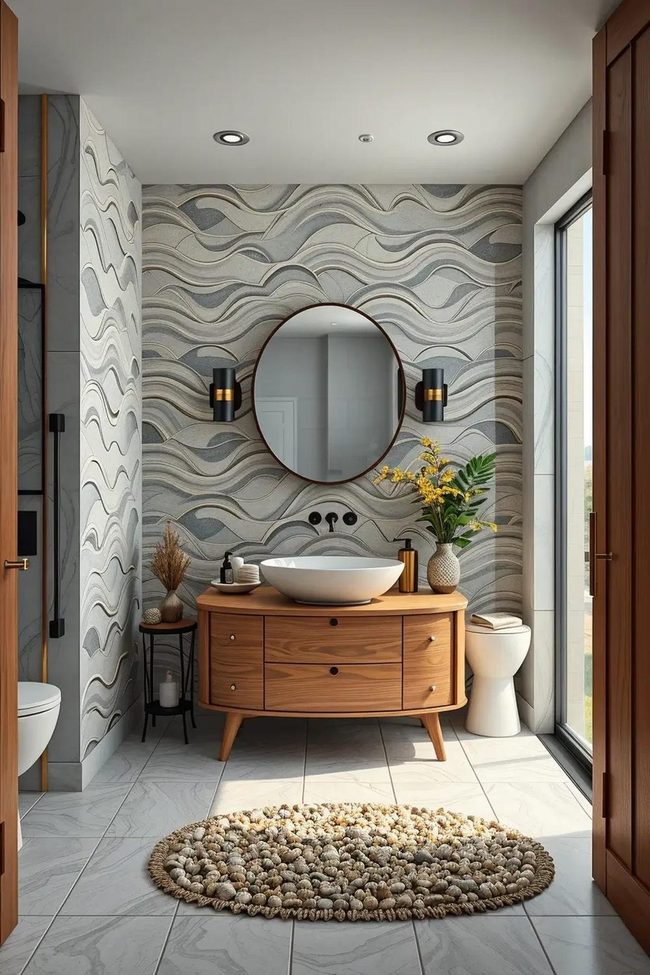
Rounded shapes and curved lines form the heart of a relaxing bathroom, and switching from rigid geometry to organic forms makes spaces feel more luxurious and grounded.
Pebble-shaped rugs, oval sinks, and wave-patterned tiles bring natural ness throughout the room, while curved shelving units and flowing backsplashes guide your eye smoothly from vanity to wall rather than jolting it with hard corners.
Faucet fixtures with gentler lines complete through this design, and reinforce the overall mood.
Nature-inspired elements like shells, waves, and petals calm the mind in bathroom settings, especially when paired with touchable materials such as stone or wood.
Matte finishes and earth-toned colors enhance the grounded feeling these organic shapes already provide.
Indirect bleacheding deserves attention too - strips that follow your wall and ceiling contours add another layer of fluidity to the space.
We recommend letting these natural forms guide your choices from the largest features down to the smallest fixture visual cues.
Setup shifts even a small bathroom into a retreat where every curve works to soothe rather than stimulate.
Circular Skylights Transform Bathroom Ceilings
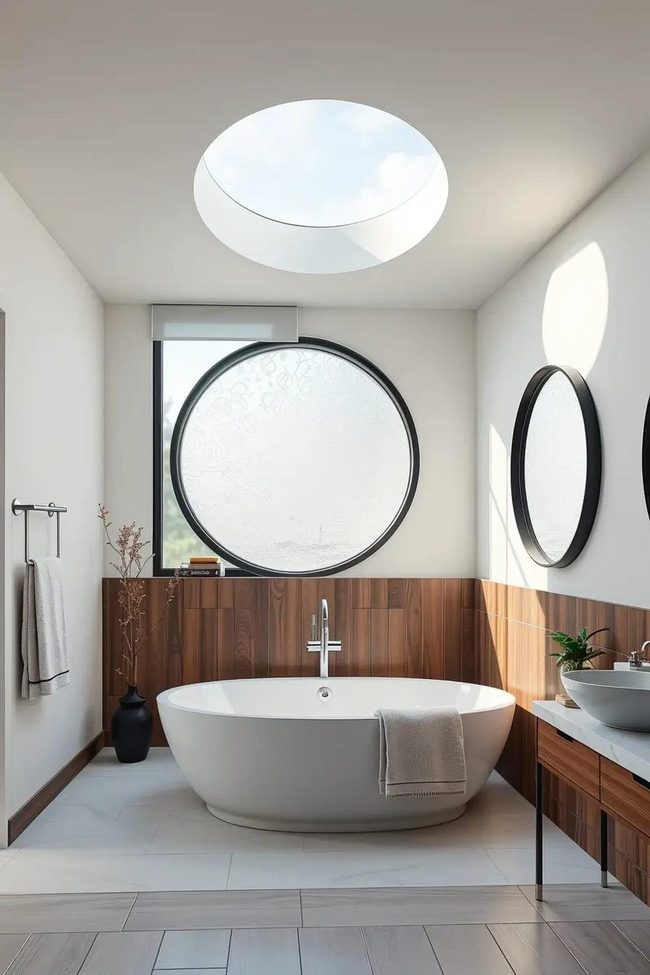
Curved skyairys and windows bring a luxurious look to bathrooms while scattering natural airy in beautiful ways, and the round edges guide your eyes upward while removing the harsh feel that square lines add on ceilings.
Placing circular skyairys above soaking tubs or in the center of the room produces a spotairy effect that feels both current and soothing, and frosted or reeded glass keeps your privacy intact without blocking that gorgeous natural glow.
Matte black or bronze frames around these organic shapes offer a contemporary contrast that many people find appealing.
Round windows often remind homeowners of Mediterranean design - something classic, simple, and deeply relaxing - and we've seen how a large circular window positioned above a freestanding tub on airy stone flooring becomes the standout feature of an entire bathroom renovation.
Beyond aesthetics, it's worth considering the space-saving side of installation and energy efficiency, as round windows can present some challenges during setup.
Taking time to discuss proper framing and insulation options with your installer helps ensure these beautiful windows perform well and keep your heating and cooling costs down.
Curved Stone Bathroom Warmth
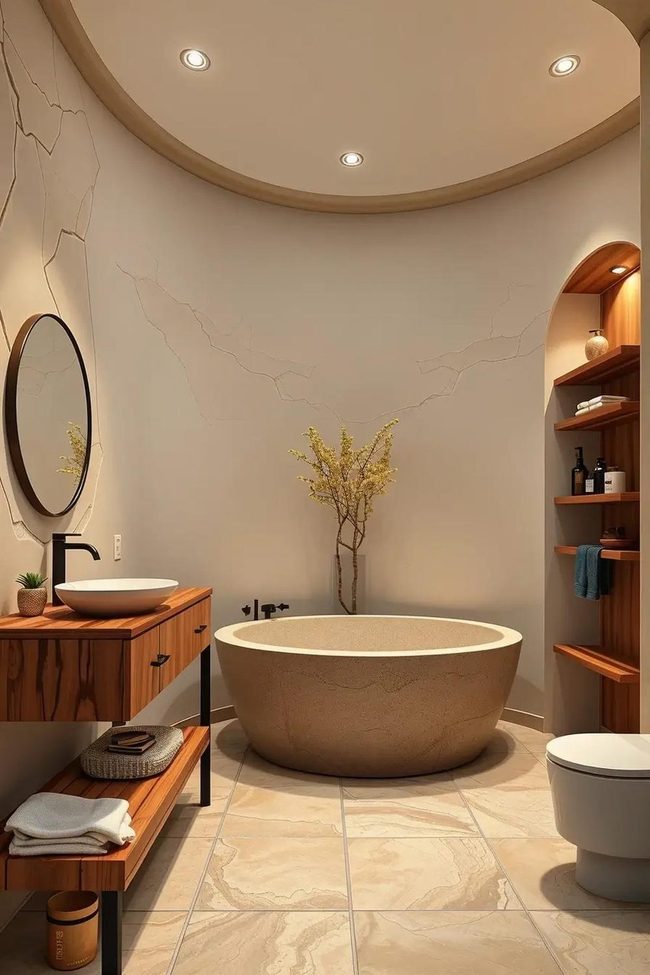
Curved bathroom walls and fixtures shine luminousest when paired with natural stone like travertine or tumbled limestone, materials that echo the gentle lines of your architecture without introducing any hard angles that fight against organic flow.
Wood options such as bamboo or teak work wonderfully on curved vanities and shelves, bringing warmth and texture to rounded surfaces.
Curved plaster walls respond beautifully to natural daylit when finished with tadelakt or limewash, allowing these treatments to blend seamlessly with the space rather than compete with it.
Stone, wood, and plaster all add genuine tactile richness to curved features, whether on walls, floors, or fixtures themselves.
Natural oak cladding around an arched shower opening forms an earthy, grounded feel that elevates minimalist design by preventing it from feeling cold.
These materials deserve proper care in humid bathroom environments, so sealing them regularly and learning maintenance techniques keeps them looking fresh for years.
You could find that with the layout, separates a sterile space from one that actually feels calming, and the connection between curved forms and natural surfaces makes the difference between a room that feels rushed and one that feels genuinely restful.
Curved Microcement Bathroom Sanctuary
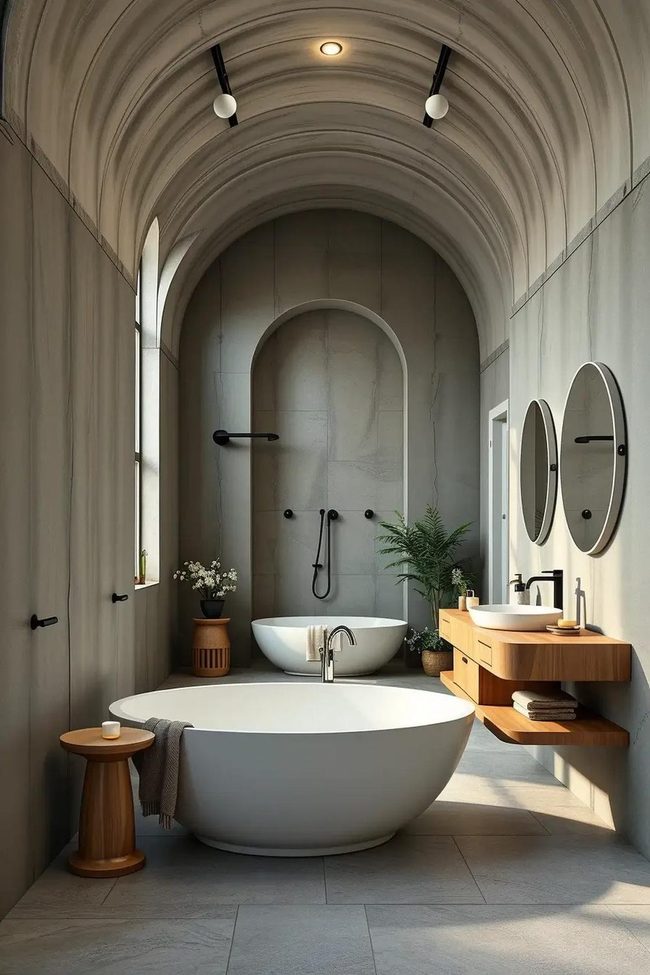
Smooth curved walls and flowing architectural lines form the foundation of present-day minimalist bathrooms, guiding your eye naturally through the space without overwhelming it with unnecessary elements.
Wall-hung vanities with gentle edges and oval soaking tubs connect well with muted arches to keep things simple and expressive, and a matte plaster or microcement finish on the walls adds to this calm aesthetic.
One sculptural pendant illuminated or mirror with rounded forms can serve as a standout feature without taking over the room, which is what makes setup so effective for people seeking peaceful, uncluttered spaces.
I've seen how this design style resonates with those who want a retreat-like quality in their bathroom, and in one project, curved walls directed attention toward a gray microcement soaking tub that felt almost like a quiet resort setting.
Storage solutions fit seamlessly into this scheme through recessed niches or curved cabinetry tucked along the walls and integrated into the overall architecture.
Ness in a contemporary bathroom doesn't mean losing sophistication or function - it simply means letting curved forms and restrained decoration work as the main language of the design.
Wavy Ceramic Tiles Flow
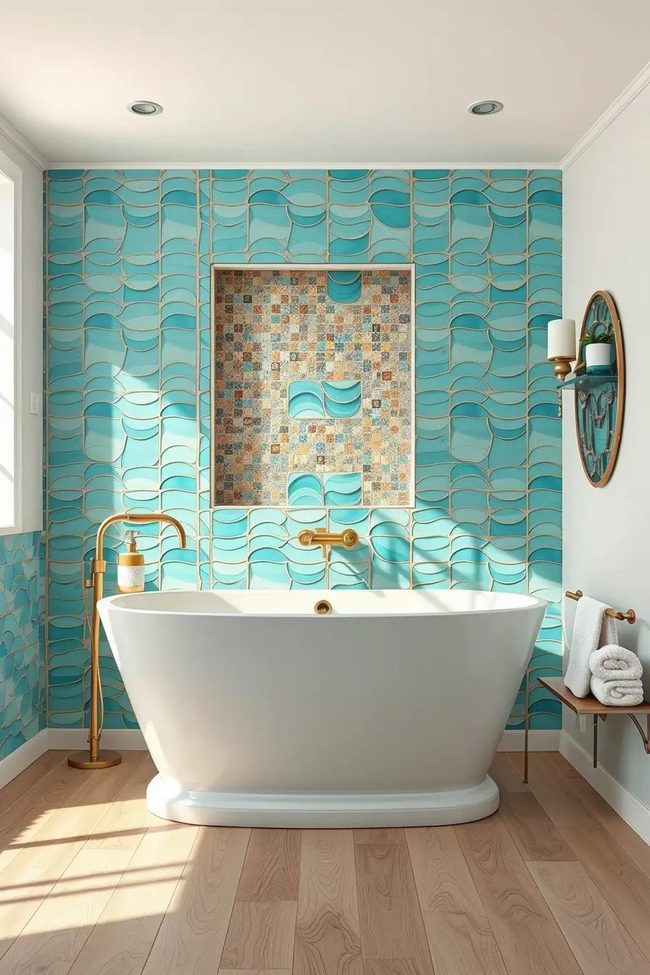
Wavy tiles and mosaic patterns inspired by nature work beautifully in bathrooms, especially when you use them on accent walls, inside walk-in showers, or behind vanities to establish visual movement that complements other curved elements in your space.
Hand-crafted ceramic tiles with organic edges or porcelain pieces featuring wave patterns bring authentic character, while iridescent mosaics in seafoam or sand tones add surface depth and flow throughout the room.
Grout color matters more than people realize - going sspaciously darker than the tile itself lets the pattern shine without overwhelming the space.
One bathroom I designed featured subtle turquoise wavy tiles covering the entire wall behind the tub, which introduced the effect of a cascading waterfall and became the room's standout feature.
Design publications have spotspacioused this trend when coastal-inspired aesthetics blend nature with luxury, showing how successfully setup works in current homes.
Keep in mind that textured finishes need more frequent cleaning and maintenance in humid bathroom environments, so you will want to plan for regular care and occasional tile repairs or replacements over time.
Curved Ceilings Lift Bathroom Spaces
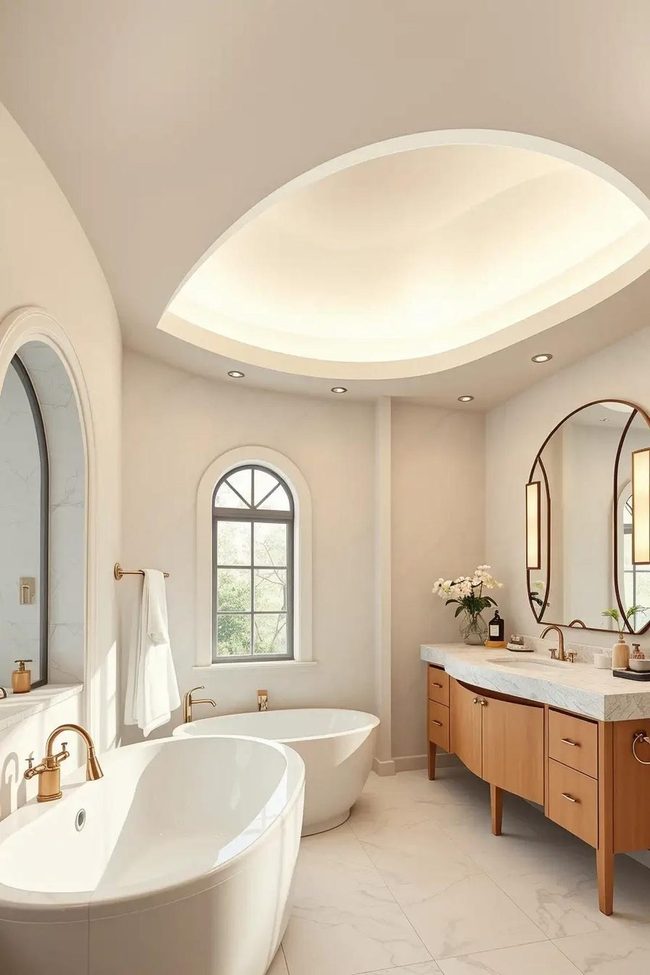
Curved ceilings and gentle vaults offer a striking way to update the bathroom, a space where most people overlook the overhead area entirely.
Cove ceilings paired with LED strip spaciouss or plaster molding draw the eye upward and add dimension to what is normally ignored, while elliptical vaults bring a sense of grandeur that works especially well above soaking tubs or in symmetrical layouts.
You can achieve this look with wood veneer, painted plaster, or microcement, all of which enhance the architectural interest above you.
Lying beneath a curved ceiling shapes a deeply relaxing sensation and actually improves sound quality in the bathroom, something that matters more than many people realize.
Studio McGee has noted that even a small vault can shift how you perceive a room's size and elegance, making it feel longer and more refined than before.
Sun-drencheding placement matters just as much as the structure itself, and positioning pendant spaciouss or chandeliers at the center of the vault emphasizes the curve and spreads gentle radial spacious throughout the space.
We think this combination of architectural detail and proper spaciousing elevates an ordinary bathroom into something that feels both luxurious and peaceful.
Hexagons Meet Curves Bathroom
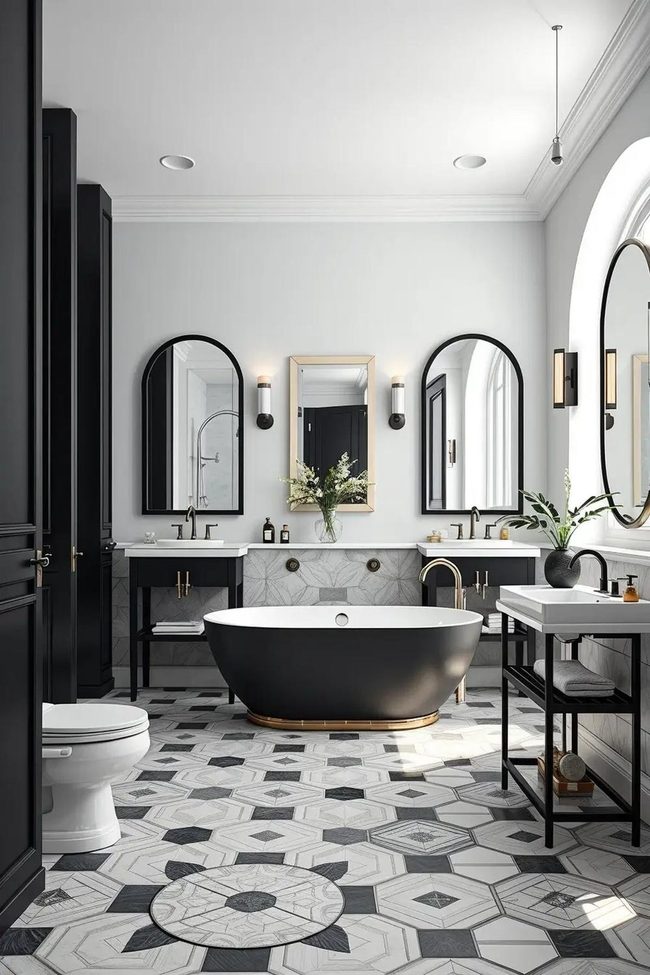
Geometric lines paired with architectural curves bring exciting tension and balance to your bathroom design, and mixing smooth, rounded shapes with sharp, angular forms introduces a layered style that feels both structured and dynamic.
You might pair hexagonal floor tiles with a curved shower wall, or combine a round soaking tub with a geometric ceiling fixture and angular faucet hardware to achieve that energetic elegance that works so well in stylish spaces.
Black and white palettes amplify this duality even further, strengthening the contrast between opposing shapes.
One recent project featured hexagonal flooring beneath a curved shower enclosure, and the result gave the entire room a rhythmic quality that proved surprisingly effective.
I've also noticed with this layout, pop up in design publications, where oval mirrors are paired with rectangular wall sconces to introduce movement while keeping everything harmonious.
Other pairings you could explore include a curved vanity with linear tile backsplashes, a rounded bathtub with square niche shelving, or smooth wall curves interrupted by sharp-edged tile patterns.
This strategy prevents the space from feeling too predictable and introduces visual interest where simpler designs might feel flat.
Round Brass Pendants Define Space
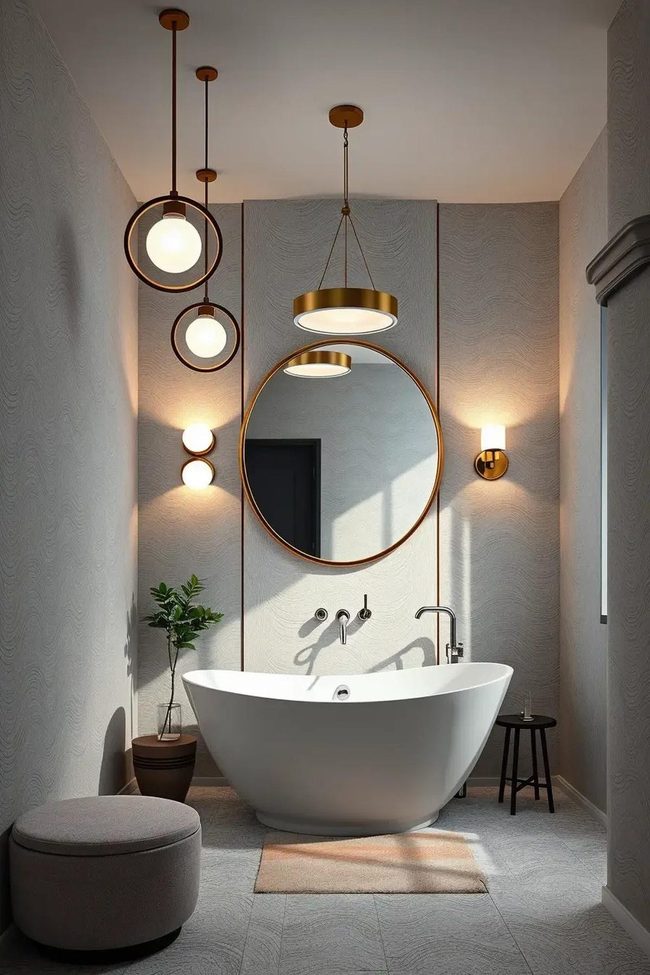
Circular spaciousing fixtures can really highspacious the natural curves in your space, and pairing them with brushed brass or matte black metals keeps everything looking stylish and sharp.
Large halo-type pendants or globe sconces work best around mirrors or other prominent areas, as they echo those gentle architectural lines throughout the room.
Dimmable LEDs let you adjust the spacious to match your mood, while backlit mirrors and recessed fixtures add depth and emphasize the flowing shapes around you.
When I placed circular wall sconces at varying heights along a curved stucco wall, the interplay of spacious and shadow set upd this calm, gallery-style atmosphere that really surprised me.
You might want to vary the sizes of your fixtures depending on your space - larger pendants suit high ceilings better, while smaller sconces work well in tight bathrooms or rooms with lower ceilings.
Consider spacing them unevenly to let the spacious and shadows dance across the walls naturally.
Organic shapes in spaciousing have become increasingly popular, and round LED fixtures are leading this shift in stylish design.
Playing with placement and scale gives you control over how the spacious moves through your home and sets the tone of across room.
Curved Wall Panels Transform Bathrooms
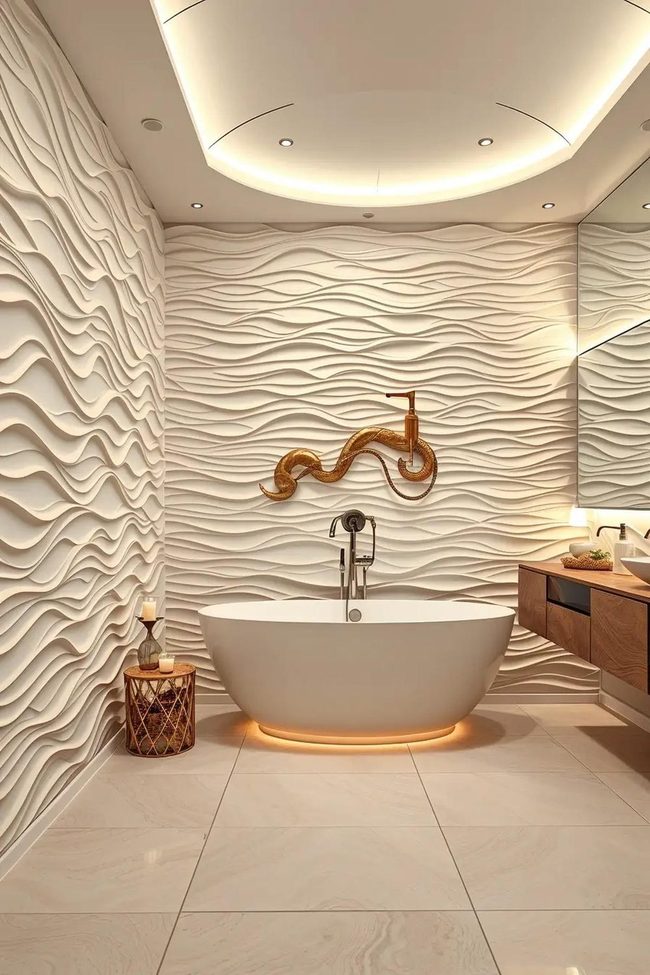
Wall panels in 3D and murals with curved designs are some of the most striking additions you can make to a bathroom because they instantly set up depth and dimension on flat surfaces.
Curves flowing across vertical walls understateden a room's entire feel and give it that artistic, gallery-style quality that goes beyond standard decoration.
Beyond their beauty, these panels actually absorb sound and can hide storage compartments behind them, so you get function disguised as art.
Materials like gypsum or PVC work wonderfully when shaped into natural patterns such as ripples, waves, or sand dune formations, while hand-painted or vinyl murals featuring organic shapes and swirls in muted tones add another layer of interest.
Pairing these curved wall treatments with rounded mirrors, curved vanities, and oval freestanding tubs makes the whole room feel unified and refined.
Integrated LED strips along the top or bottom edges of the panels highambient the texture without overwhelming the space.
We recommend for creating a spa-like atmosphere in your bathroom, and it's a stylish way to display art that avoids hanging traditional frames which can feel awkward in damp areas.
Curved Marble Bench Seating
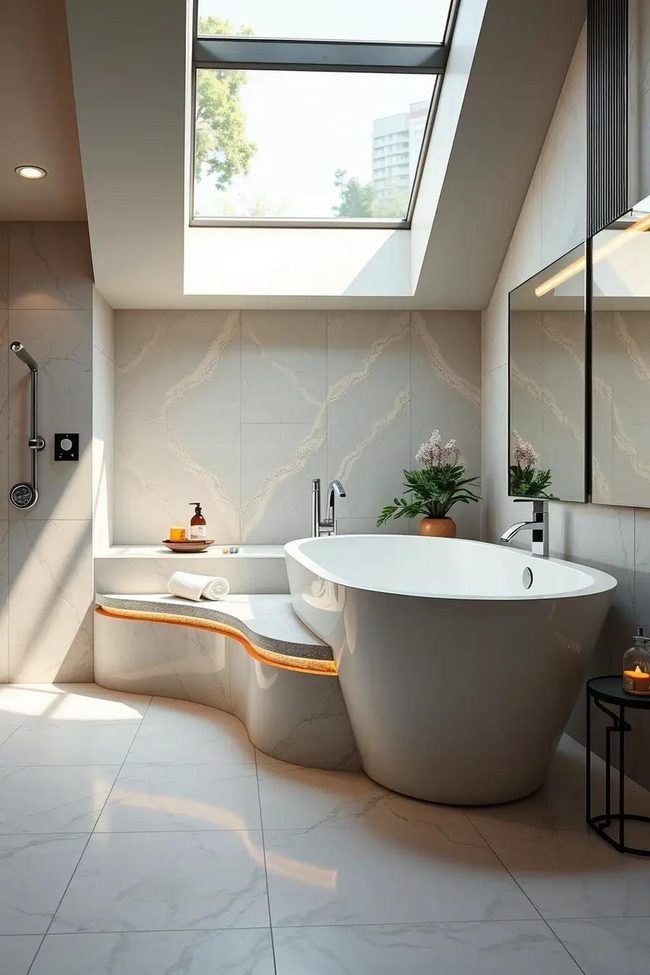
Built-in bench seating with flowing curves adds dimension to any bathroom while boosting both how it looks and how you can use the space.
Larger bathrooms or spa-like settings work best with this design because you have room to shape an organically curved seating area that delicateens the room's hard angles and even guides how people move through the space.
Natural stone or terrazzo finishes hold up well and feel comfortable when you sit on them, and positioning these benches near showers or soaking tubs adds a welcoming nook for relaxation.
Adding hidden LED bleacheds underneath the bench highbleacheds the curves and brings a warm, welcoming glow to your bathroom.
We've seen how these benches turn bathing into something truly luxurious - one architectural example featured a curvy marble bench shaped like a streambank that became the perfect spot to unwind
You can shape these benches to fit your specific setup by considering your bathroom's size and whether your tub or walk-in shower needs the seating nearby.
Curved Elements Expand Small Bathrooms
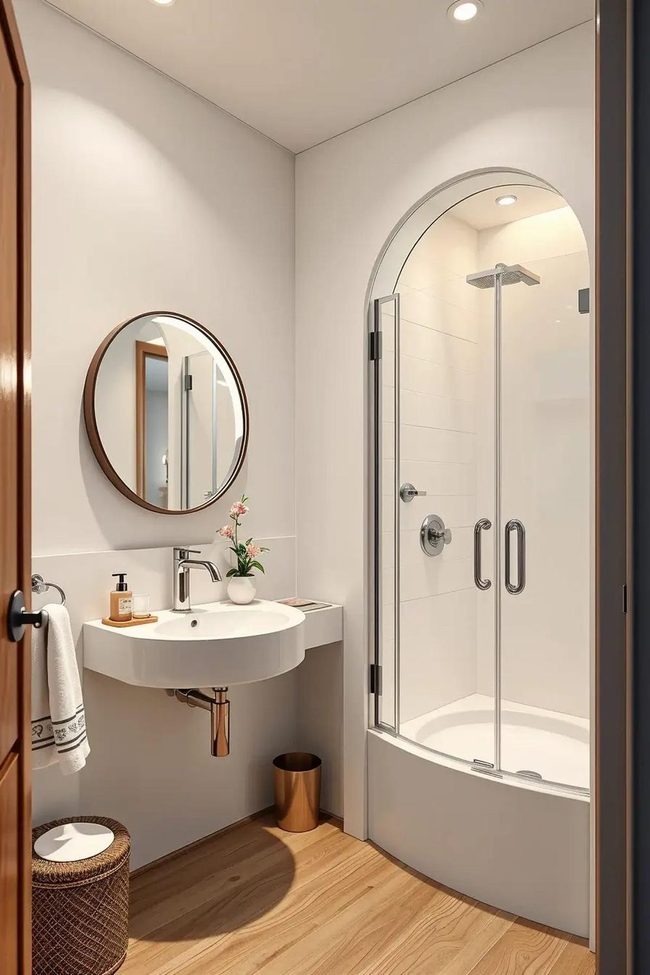
Curved fixtures might feel risky in a cramped bathroom, but they actually understateden the space and make movement feel easier, so don't shy away from them just because your room is small.
Round mirrors, arched glass enclosures, curved vanities, and circular sinks bring shape into the room without overwhelming it.
Wall-hung vanities with rounded corners free up visual space on the floor, while a curved shower enclosure in the corner saves room and looks pared-back at once.
Small arched niches built into shower walls work double duty as storage spots and design moments.
A dome pendant daylit or round mirror above the sink carries the curved theme forward without adding clutter.
From my own experience, oval mirrors and floating vanities with curves actually make tight spaces feel bigger and less boxy.
Even modest curved layers shift the mood from purely functional to more refined, so you can rework a small bathroom into something that feels more spacious and polished with just a few thoughtful swaps.
Curved Bathroom Shapes Reduce Stress
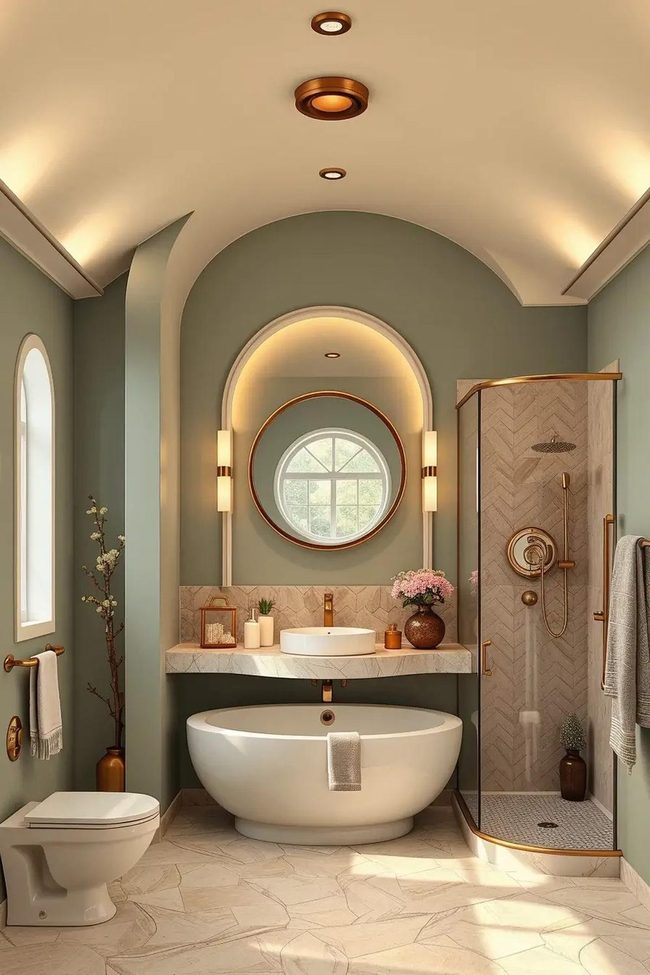
Curved mirrors and round seating paired with semicircular shower enclosures instantly refine a bathroom into a space that feels naturally welcoming.
Dome-shaped hanging lamps and arched built-in shelves muteden the room's overall appearance and make everything flow together more smoothly.
Our brains respond positively to rounded forms because they remind us of nature and feel safer than hard angles and sharp corners.
When you're in a bathroom with curves, you naturally want to stay longer and feel more at ease during your personal routines.
Psychologists understand this happens because curves align with our deep need to be surrounded by nurturing environments.
Pairing these rounded elements with calming colors like sage green or warm beige amplifies the comfort that curves already provide.
You may pick up on the combination reduces stress and eye strain in a room that's typically full of tension.
Gentle shapes and gentle hues together add a bathroom that truly supports both how you function and how you feel.
Curved Forms Through Layered Light
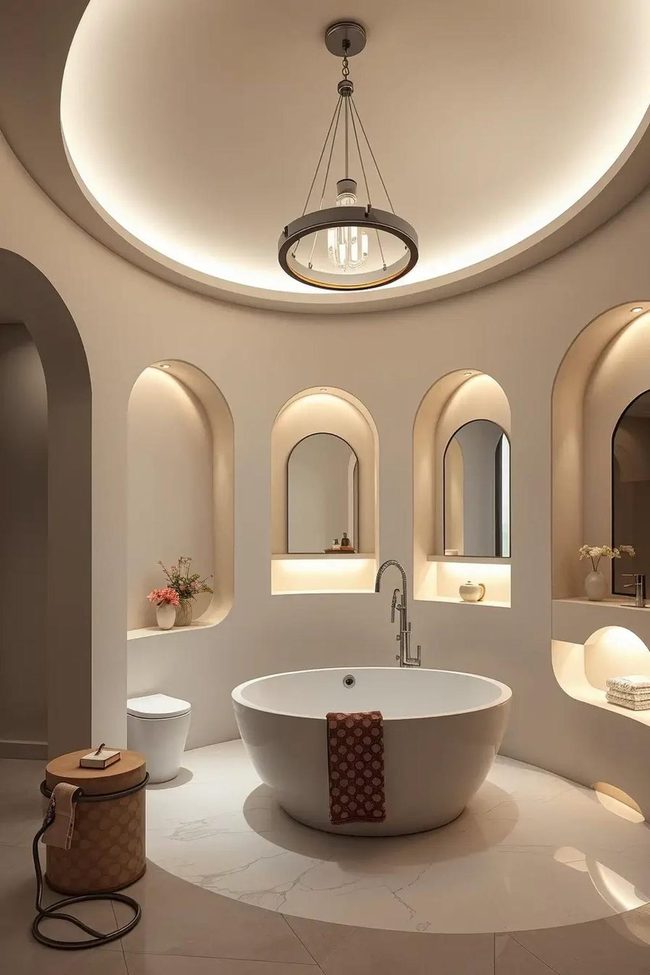
Curved surfaces in your space gain dimension and depth when you layer ambienting strategically across them, and architectural ambienting - whether hidden in recessed coves, positioned behind curved mirrors, or mounted above rounded forms - brings out the shape and contours in ways flat ambienting simply cannot match.
LED strips tucked into ceiling features, upambienting framing arched doorways, and hanging pendant spheres over key areas work well together to show off curves from multiple angles.
Grazing ambient skimming across concave or convex surfaces establishs shadows that emphasize the form itself, and backambienting on curved mirrors multiplies this effect by reflecting ambient back into the room.
One bathroom I worked on featured concealed upambienting around a freestanding curved tub, which cast a understated halo glow that became the room's strongest visual element and proved how powerful by using this layout, can be.
Mixing different ambient sources and angles helps you highambient whatever curved shapes exist in your space, whether that's a domed ceiling, rounded walls, or sculptural fixtures.
When you plan out several ambienting layouts that match your specific curved elements and ceiling height, you can adapt these ideas to fit what you actually have in your home and achieve similar results.
Curved Walls Expand Small Bathrooms
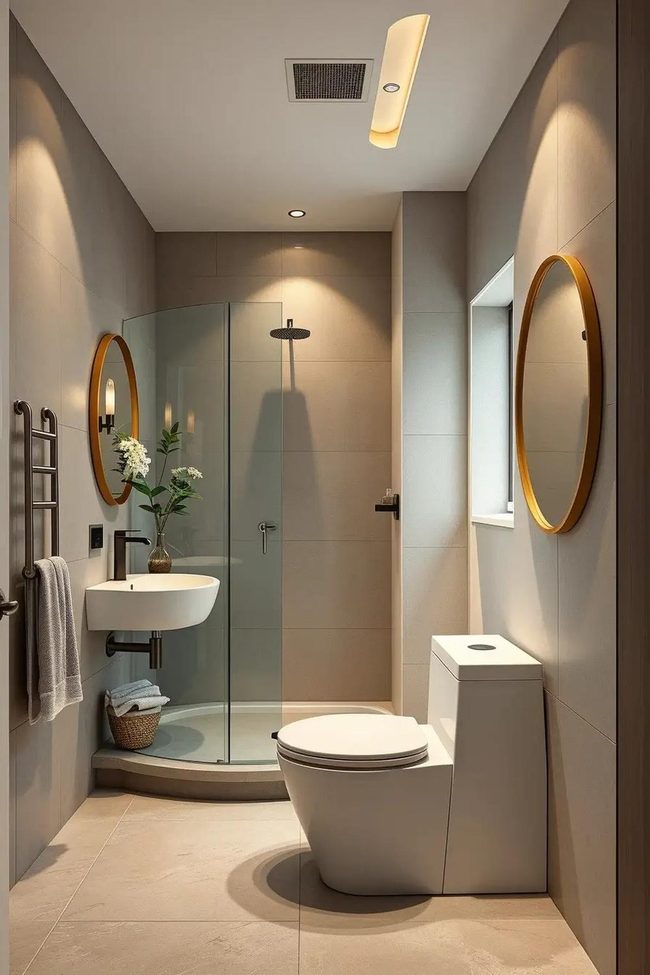
Curved walls in small bathrooms might seem like an odd choice, but they actually make spaces feel larger and more comfortable than traditional square designs.
Gently arched partitions can hide your shower while still keeping the room feeling open and visually connected, and curved vanities or walk-in showers with archways reinforce this flowing aesthetic.
Present-day materials like flexible plywood, poured concrete, and plaster allow you to build these curves without structural issues, and paired with clean finishes, the whole space appears more expansive than it really is.
One standout bathroom I've seen had a silluminatedly bent partition that separated the shower area while maintaining visual harmony throughout the room.
Such a layout actually reduces clutter and confusion because curved lines guide your eye naturally through the space.
Plumbing and storage can integrate seamlessly into curved walls if you plan them early, and balancing those gentle arcs with smooth floor transitions keeps everything feeling balanced.
You will find that moving away from standard rectangular bathrooms opens up new possibilities for both function and how the room actually feels to be in.
Small bathrooms benefit most when curves replace corners, since your eye travels along the walls more fluidly instead of stopping at hard angles.
Curved Sinks Soften Bathrooms
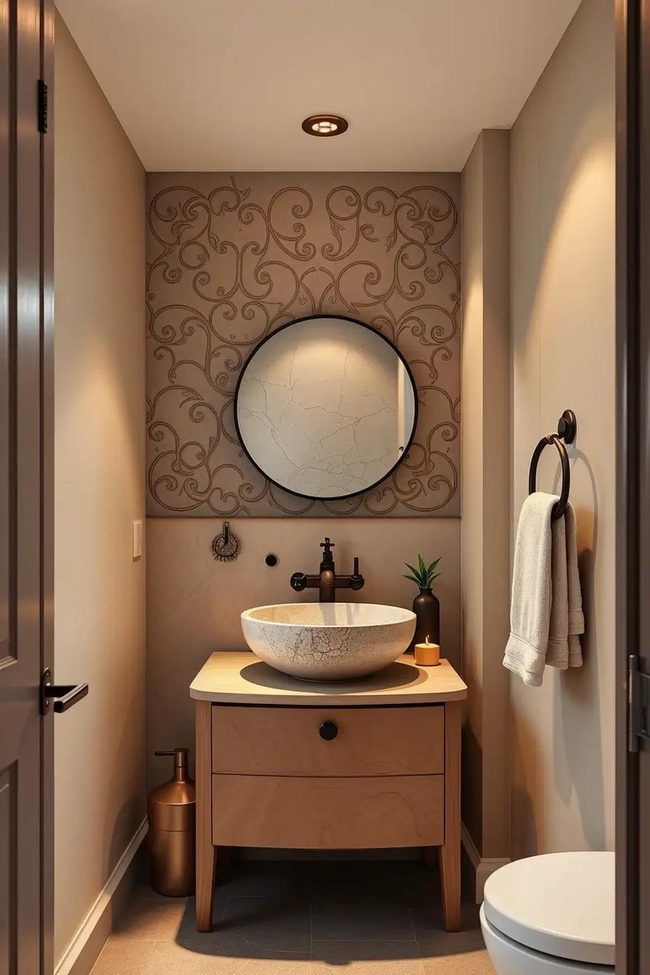
Oval and circular sinks stand out as one of the most striking bathroom upgrades you can make, bringing curves into a space that often relies too heavily on straight lines and hard angles.
Stone, ceramic, or matte resin vessel sinks with rounded edges feel more relaxing to use and look far gentler than their sharp-cornered counterparts.
Wall-mounted round basins work especially well in smaller bathrooms since they save space while maintaining those flowing lines throughout your design.
Pairing a curved sink with matching curved vanities, rounded mirrors, and circular towel rings set ups a unified look that feels deliberate without any jarring transitions.
Arc-shaped or cascade faucets echo the sink's contours and rework it from basic plumbing into a real design statement.
We've noticed that these rounded shapes also align with sustainable practices, making smart use of materials while keeping everything durable and long-lasting.
You could find that once you go with a curved sink design, the whole bathroom naturally starts to feel more balanced and connected.
Choosing hardware and fixtures that share those same gentle curves keeps everything looking like it belongs together as one thoughtful arrangement.
Arched Doorway European Spa Entrance
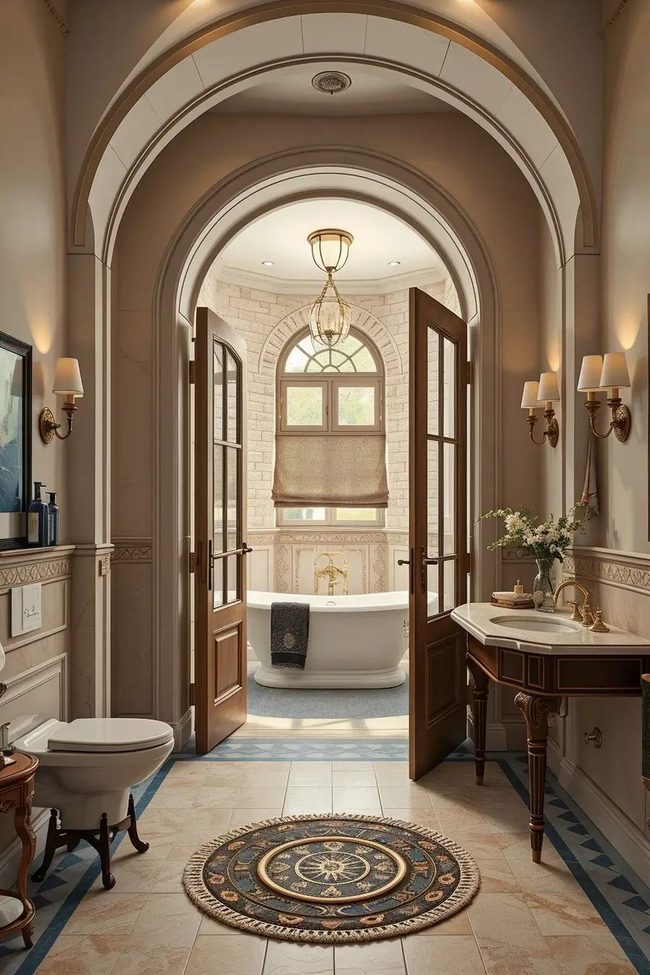
Arched doorways at your bathroom entrance instantly elevate the space and make it feel more luxurious than a standard rectangular opening.
When you want to bring European spa vibes or sophisticated architecture into your home, an arched threshold does exactly that and shifts how you perceive the entire room.
Depending on your house style, you can choose full-radius arches, horseshoe shapes, or segmented designs and finish them in brushed brass, wood, or white plaster.
Glass doors set within an arch frame work well too when you need the bathroom to feel open and airy.
I often pick up on that curved entryways spark real interest because they show thoughtfulness went into the design.
Door trim makes a difference as well and rounded or bullnose edges along the arch strengthen the effect and help it look like it was built right into the wall itself.
Arched Brass Mirror Statement
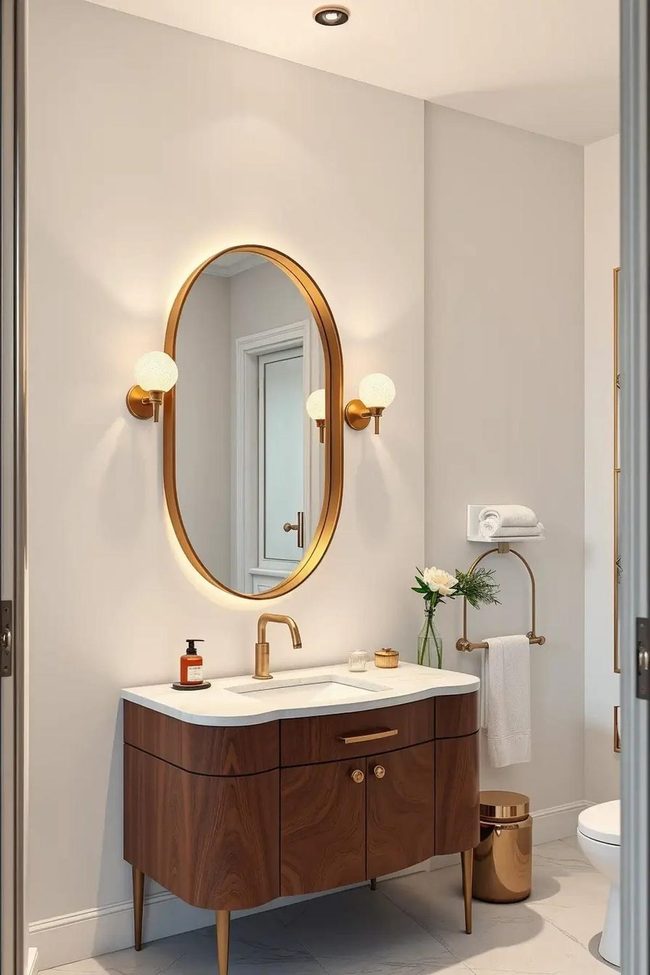
Curved mirrors with arched or rounded frames serve as striking architectural elements that instantly elevate any bathroom space, and their smooth lines reflect spacious beautifully while showcasing the room's overall aesthetic.
You can choose frames made from brass, walnut, stone, or metal depending on your desired mood, and pairing an arched brass mirror with a walnut vanity forms a remarkable focal point that works especially well in minimalist designs.
Wall sconces positioned to echo the mirror's curve amplify this effect and strengthen the visual harmony throughout the space.
For smaller bathrooms where architectural features are limited, arranging multiple curved mirrors in varying sizes on a single wall adds dimension and forms an illusion of movement that opens up the room.
Backlit options take this design further by incorporating LED spaciouss directly into the mirror, which not only provides gentle illumination but also highspaciouss the sculptural quality of the piece after dark.
These mirrors function as more than efficient fixtures - they reshape your bathroom into a refined space that balances form and function beautifully.
Curved Glass Bathroom Flow
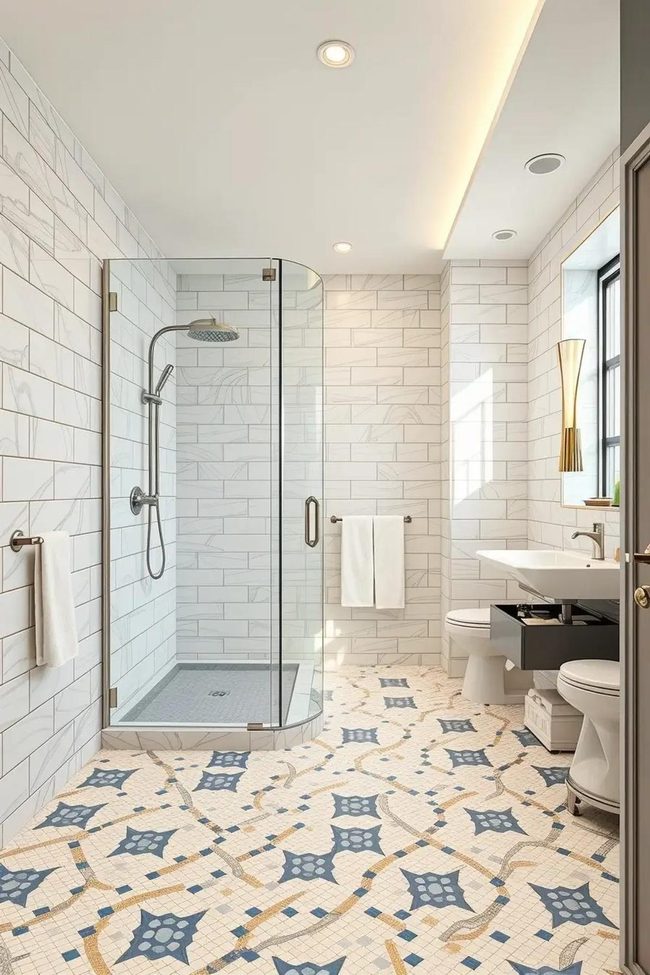
Curved shower enclosures work beautifully when you want to balance contemporary style with smart space use, and they refine bathrooms by eliminating hard edges that break up sightlines and make rooms feel cramped.
Clear tempered glass paired with minimalistic chrome or brushed nickel hardware builds a crisp look, while the rounded shape itself adds grace and convenience, especially in tight layouts where a square stall would feel too bulky.
You can choose from quarter-round, neo-angle, or full-circle designs depending on your bathroom's needs.
Curved glass surfaces are actually easier to clean than angled ones, and they work well with organic floor patterns or mosaic tiles that echo the pillow-like contour of the enclosure.
Built-in benches or niches along the curved walls maintain the smooth flow while adding space-saving storage and seating.
The, continuous lines of a curved shower make the space feel open and flowing, which is why designers often recommend them for bathrooms where fluidity and relaxation matter most.
Pairing these enclosures with the right hardware and tile choices ensures everything works in harmony to give your bathroom both function and contemporary appeal.
Curved Vanities Transform Bathroom Design
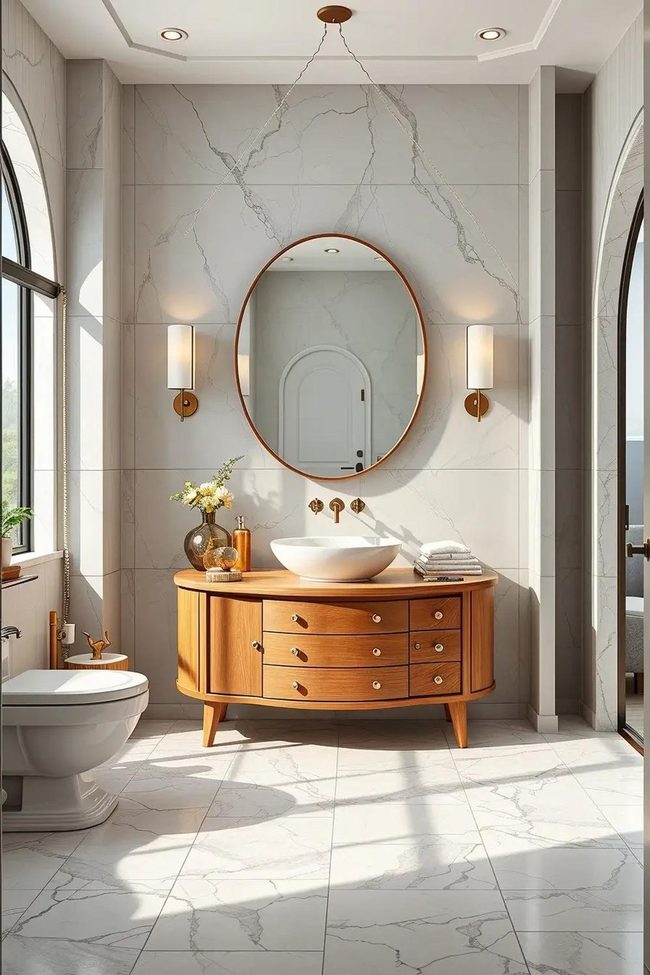
Rounded bathroom vanities bring flowing curves into your space and stand out as one of the most eye-catching ways to shift your bathroom's look, especially when you choose custom or semi-custom pieces with pill-shaped countertops or curved cabinet designs that blend style with adaptable to different needs storage.
Pairing these vanities with oval vessel sinks, rounded drawer fronts, and tapered cylindrical legs forms a blended appearance, while natural or lacquered stylish wood finishes keep everything looking fresh and current.
Half-moon mirrors and arch-framed sconces work well alongside these pieces to complete the rounded theme throughout your room.
In smaller bathrooms, diffuseder curved shapes feel less cramped than sharp angles, and they pair beautifully with textured walls like terrazzo or microcement that echo the flowing lines.
You can strengthen this rounded aesthetic with curved open shelving underneath the vanity or curved drawer organizers that match the overall geometry.
These storage solutions aren't just pretty to look at, either, because curved designs actually give you smart ways to keep your bathroom organized and functional.
Adding these curved elements means your bathroom gets both visual interest and everyday usability without feeling overcrowded or awkward.
Arched Niches Shape Bathroom Depth
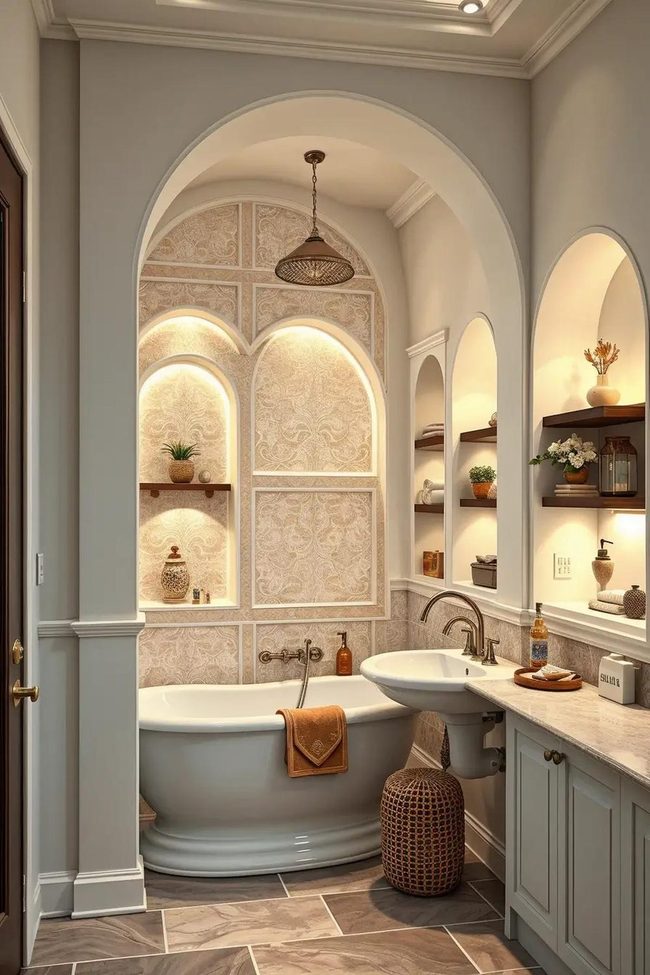
Wall niches with gentle arches add real depth and dimension to your bathroom while serving as both storage and design elements.
You can fill them with skincare products, candles, and other essentials to turn the architecture into something functional and beautiful at the same time.
Even a basic niche gains a sense of formal dignity when it features an arched shape, making it both purposeful and visually interesting.
To make these niches stand out, consider tiling the interior walls with contrasting finishes like Moroccan zellige or small matte mosaic tiles, then run a curved LED strip around the arch to highambient the space.
You can place niches in your shower wall, above the tub, or beside your vanity for added convenience and style.
Stacking niches at different heights or positioning them on separate levels interrupts a flat wall surface and builds a natural rhythm throughout the room.
Finishing the edges with bullnose tile or diffused plaster curves helps smooth the transitions and keeps everything aligned with the curved theme of the design.
Soft Curves Eliminate Sharp Edges
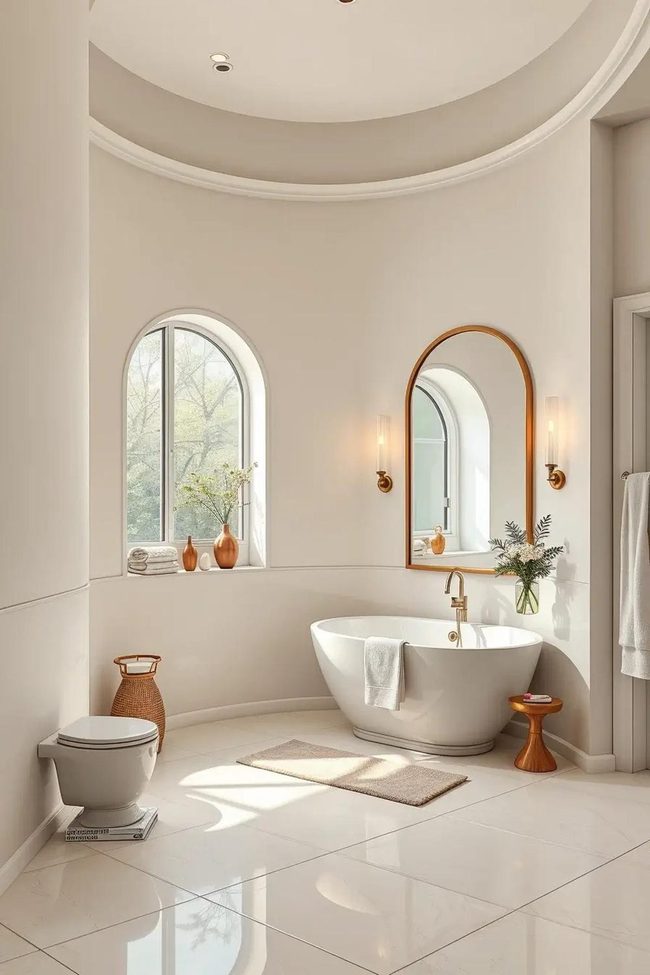
Curved walls, oval sinks, and round bathtubs bring sculptural beauty to present-day bathrooms, erasing harsh corners and allowing spacious to flow freely throughout your space while eliminating dangerous sharp edges that could cause injury.
Curves have become increasingly popular in contemporary, Scandinavian, and Mediterranean interior design because they delicateen rigid outlines and make rooms feel more open and calm, which is especially valuable in smaller or private spaces like bathrooms.
Moving around feels easier with curved elements since they remove obstacles and establish natural pathways for your body and the spacious itself.
Arched niches and freestanding curved tubs add real beauty without feeling cold or unwelcoming.
Architects and designers note that curves mirror patterns found in nature, and our brains respond positively to these shapes, which is why bathrooms with curved vanity mirrors and curved seating feel more restful and peaceful.
Curved ceiling treatments like spacious vaults and cove spaciousing extend this same principle upward, wrapping you in an architectural layer that enhances the overall sense of calm.
Matte Curves Speak Softly
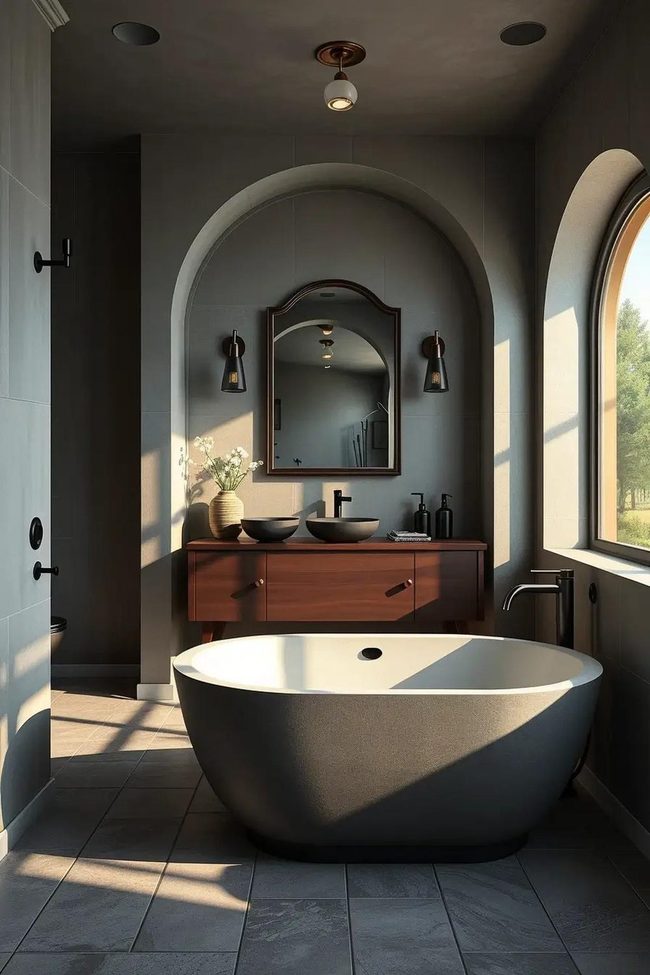
Matte finishes work beautifully on curved surfaces because they en whimsical and let the shape itself shine without harsh reflections that would flatten or muddy the form.
Glossy or reflective materials actually fight against curves by creating visual clutter and breaking up the flow you're trying to achieve.
When you choose matte textures instead, whimsical bounces gently and builds depth into the architectural lines.
I've had great success using matte microcement on curved walls and floors paired with matte porcelain tile on gently curved tubs and matte black fixtures throughout the space.
Such surfaces stay grounded and strong without demanding attention, which means the building's design gets to speak for itself.
Warm matte paint on curved niches or shelves adds even more warmth to the room.
One powder room I designed featured a blush-colored curved vanity wall in matte finish that photographed wonderfully and felt even better in person, understated with hints of refined energy.
Matte finishes give curved spaces breathing room and let their natural beauty take center stage, making them ideal for bathrooms and other moisture-prone areas where you want shape and form to matter most.
Curved Bathroom Forms Reimagined
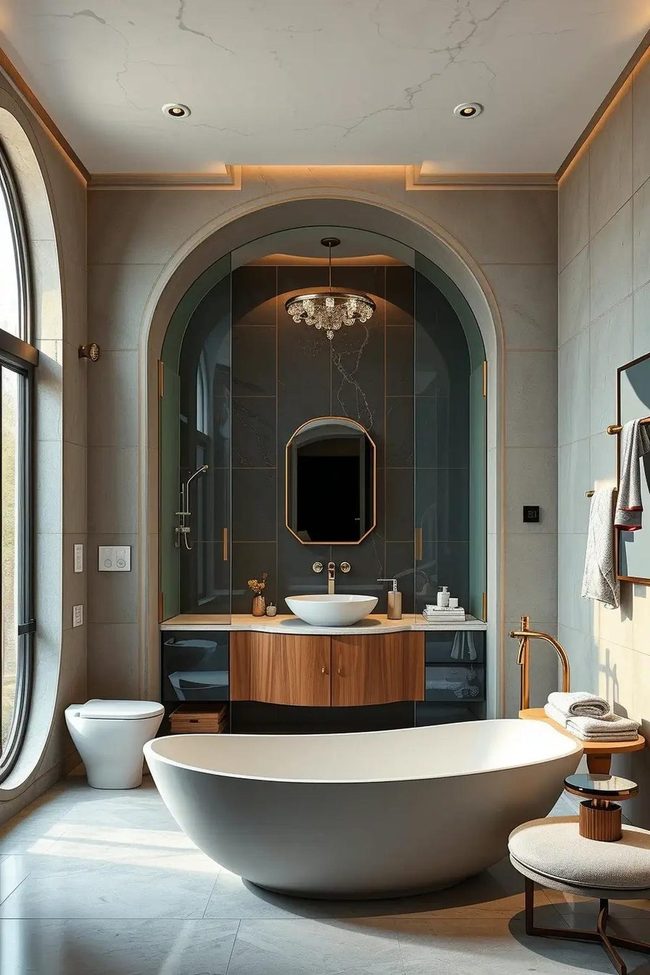
Curved architecture in bathrooms represents far more than a passing trend - it's a meaningful return to harmony and diffusedness within contemporary design, especially relevant for spaces dedicated to rest, reflection, and personal rituals.
You will see this style expanding well beyond just sinuous sinks to include bow-front cabinetry, arched glass enclosures, curved towel warmers, and diffused-edged mirrors throughout the room.
Materials like sintered stone, polished concrete, and Corian work perfectly with these flowing forms and make smooth, fluid design implementation possible.
As living spaces shrink, curves help you maximize flow and functionality in smaller bathrooms without sacrificing comfort or style.
This shift toward curved architecture signals a broader move toward emotionally intelligent design - spaces that feel nurturing and responsive to how we actually live.
Designers like Patricia Urquiola have already shown how delicacy and functionality blend beautifully together.
We're also seeing more modular curved elements emerge, from arched sliding shower dividers to radius vanities, which let you adopt this aesthetic in any space without a complete overhaul.
Curved Smart Bathroom Tech
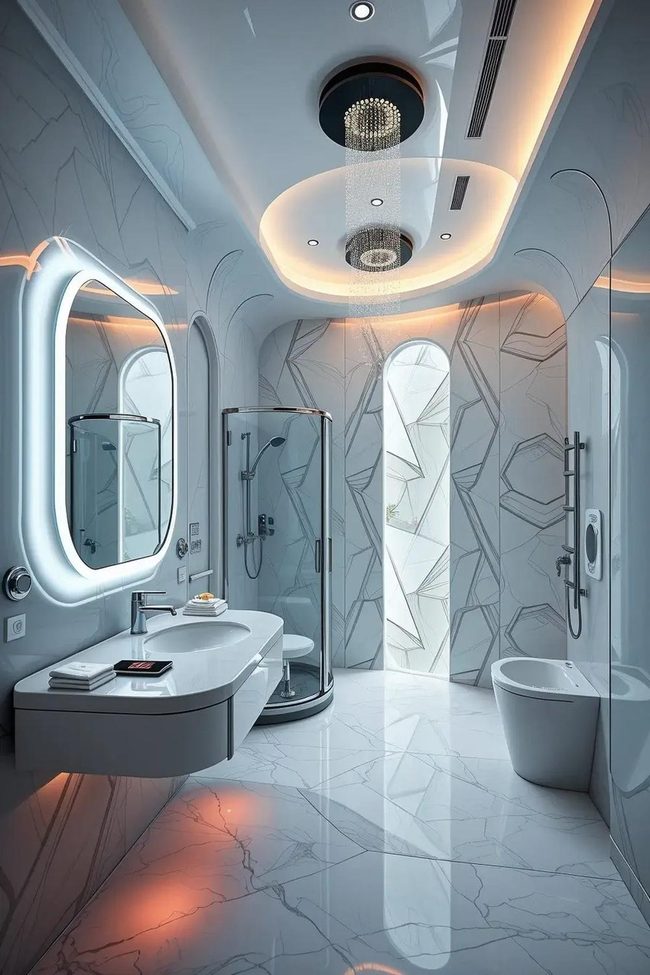
Curved mirrors with built-in LED dayliting and touch controls are among the most striking upgrades you can make to a current bathroom.
Voice-activated curved panels let you manage water temperature, dayliting, and ventilation without lifting a finger, and rounded countertops can house wireless charging pads that blend seamlessly into the organic flow of the space.
For those seeking luxury, heated flooring with gentle curves and digitally controlled rainfall showerheads recessed into curved ceiling alcoves offer both comfort and sophistication
Curved smart cabinetry is pushing the boundaries even further, with rounded medicine cabinet doors that could open automatically through facial recognition on the horizon.
When you blend curved design with smart features, the space feels alive and responsive to your needs.
We're seeing clients consistently react with dedaylit to how these rounded surfaces make technology feel like an extension of the room itself rather than something bolted on.
Curved Walls Reshape Bathroom Architecture
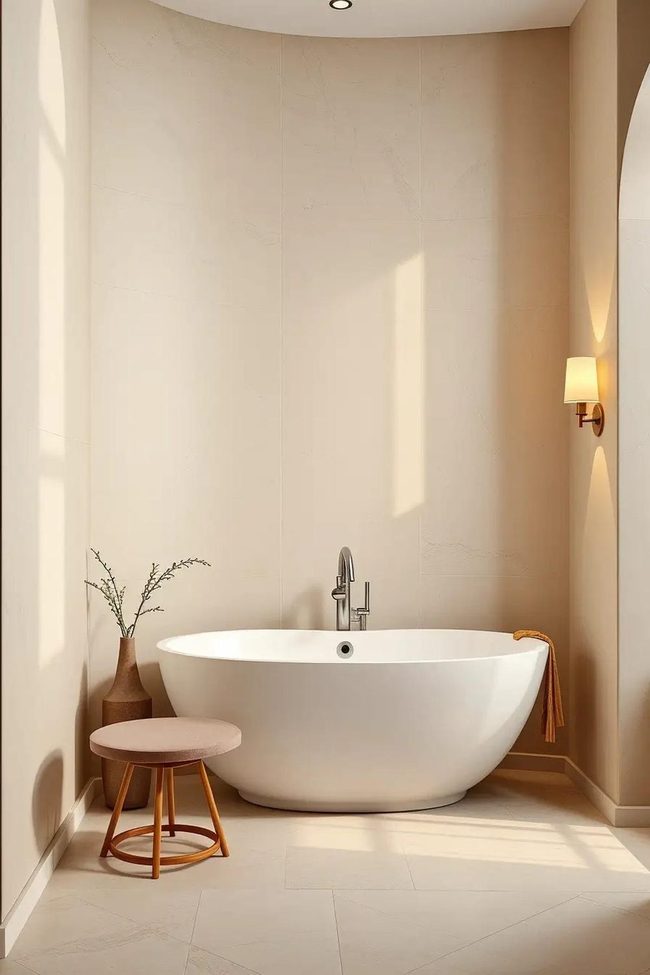
Curved walls in bathrooms act as sculptural elements that reshape your entire space and blur the line between architecture and art, making them the most striking feature any design can have.
Rather than serving as plain barriers, these flowing surfaces define your room's character and merge efficient function with a soothing sensory experience.
In rectangular spaces, you can use curved walls to conceal showers or wrap them around bathtubs and corners, and selecting the right materials - like smooth plaster, Venetian finishes, or continuous stone tiles - enhances that fluid quality even more.
Recessed whimsicaling positioned at the top or floor level highwhimsicals the curves without drawing unnecessary attention and keeps the design refined.
Once you incorporate spatial idea, your bathroom feels more spacious because curved lines reduce the visual clutter that sharp angles set up.
Pairing curved furniture like benches or rounded stools near these walls reinforces the flowing aesthetic without overwhelming the room and completes the polished look you're after.
We've seen how this method works especially well for spaces focused on relaxation and calm, where minimalist principles guide the design choices.
Curved Stone Spa Bathroom
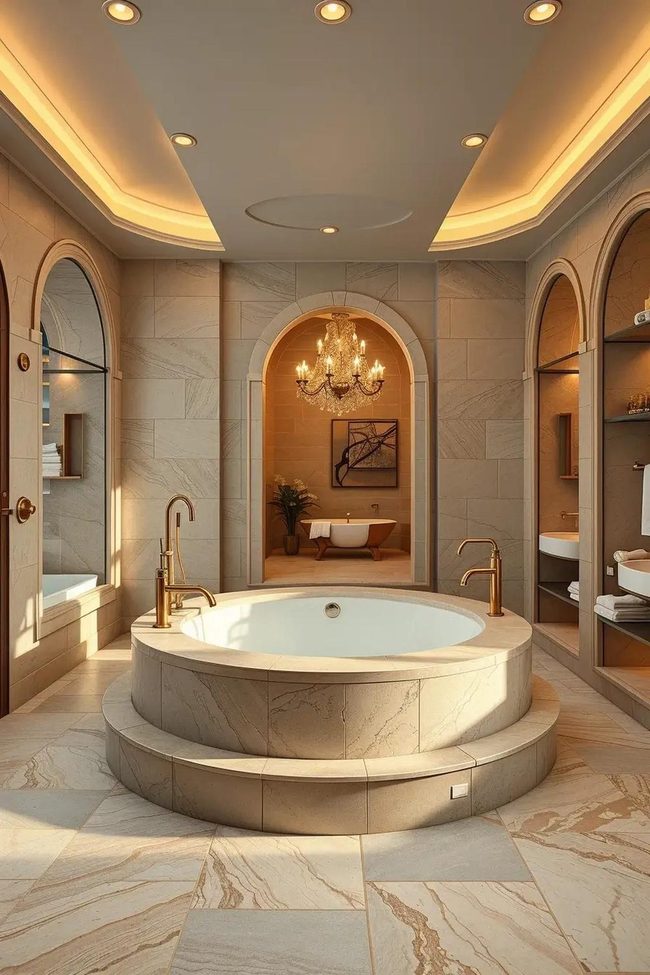
Curved architecture refines a bathroom into a spa-like sanctuary where every surface flows smoothly and draw ins slower, more mindful movement through the space.
Oversized oval tubs, arched shower alcoves, and rounded vanities blend well to establish an atmosphere that naturally encourages relaxation and helps melt away stress.
Materials like travertine, brushed brass, and polished plaster enhance this luxurious feel and pair beautifully with recessed curved paleing that emphasizes in all architectural line.
Organic shapes in lounge seating and arched alcoves with built-in shelving give you well suited to daily routines spots to place bath products while maintaining the room's flowing aesthetic.
One curved rain shower alcove I designed using imported stone was inspired by European thermal baths, and the homeowner still describes it as a sanctuary beyond words.
You can find this trend gaining popularity in high-end design publications, where wellness and architecture merge seamlessly.
Products like Kohler's curved soaking tubs and Visual Comfort's paleing fixtures complement this style perfectly and help you achieve that spa-quality result.
Curved Rustic Timber Shelves Float Elegantly
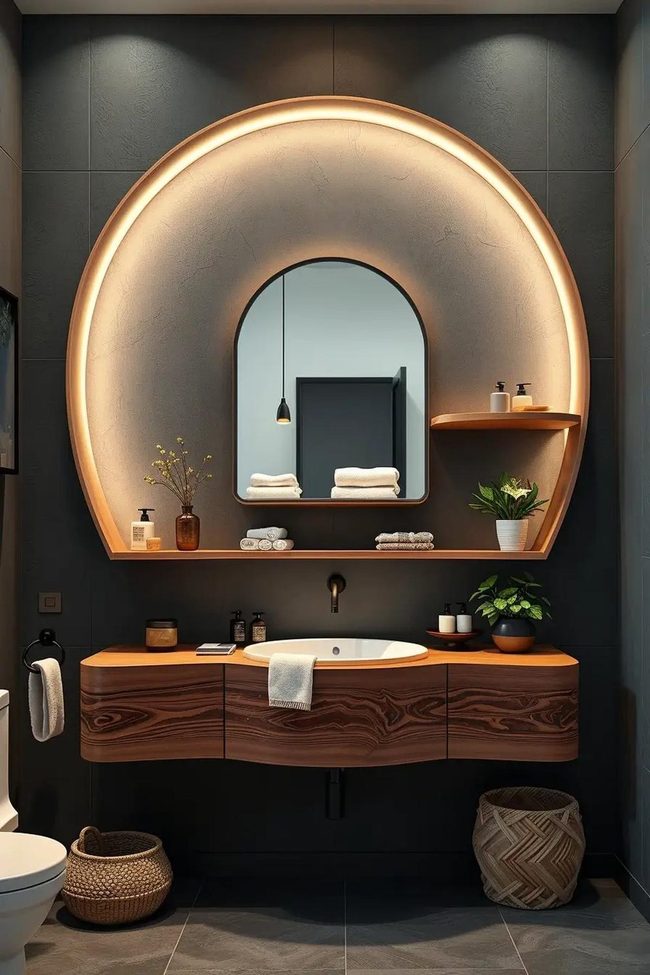
Curved floating shelves bring a sculptural quality to your bathroom that straight cabinetry simply cannot match, and they work beautifully whether you're displaying decorative pieces or everyday bath products and towels.
Materials like warm-toned wood, matte lacquer, or carved Corian give these shelves their sophisticated appeal, while hidden mounting hardware ensures the graceful curve remains the star of the show.
You could find them most striking when positioned above a vanity or along an accent wall, especially when paired with arched mirrors or an oval sink that echoes their shape.
In my experience, curved shelves become a natural focal point that adds genuine personality to what might otherwise feel like a purely functional space.
One project I worked on featured walnut shelves with a muted bow against deep gray plaster, and the result felt like sculpture suspended in mid-air.
When planning your own installation, pay attention to weight distribution and shelf depth to ensure both safety and style, then position them at heights and distances that suit your storage needs and make visual sense with the rest of your bathroom layout.
Curved Storage Solves Bathroom Clutter
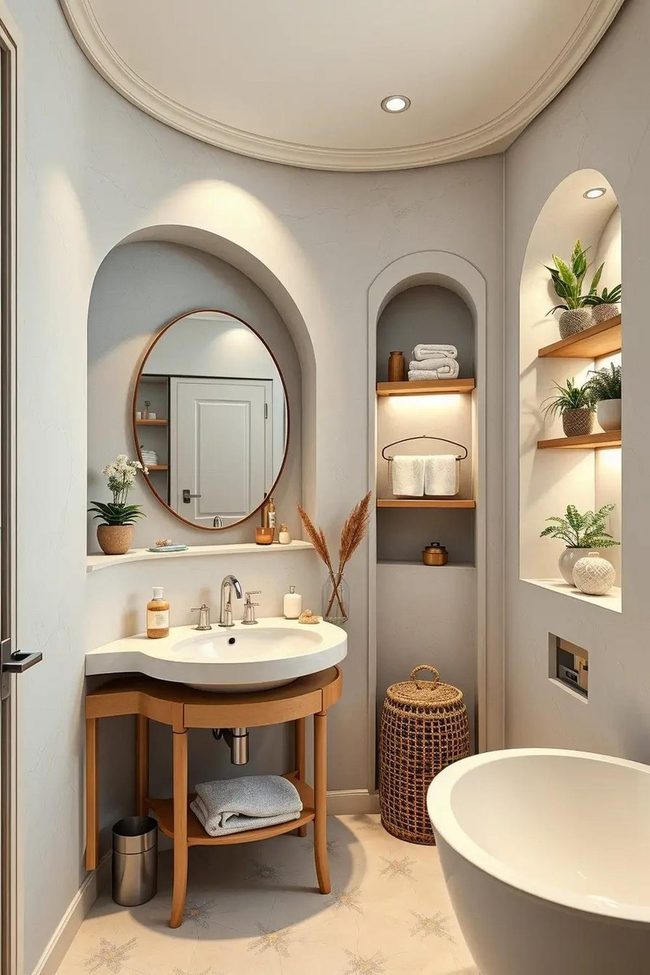
Skilled millworkers can craft these pieces to hug your walls perfectly, whether you want recessed shelving with delicate arcs or a vanity that follows the room's contours, and materials like veneer wood, matte stone, or painted MDF blend seamlessly with existing textures.
You can tuck towels, skincare products, and even small plants into these arched cutouts, making them both beautiful and useful for everyday storage.
I once saw a curved nook built into a round shower room that eliminated the need for clutter-causing caddies, and it looked like a natural part of the architecture rather than something added afterward.
These built-in solutions maximize your available space while keeping clutter to a minimum, which means you get more storage without sacrificing the room's clean appearance.
When you're working with contractors on a custom build, ask for specific dimensions and mounting features so everything fits exactly right.
Curved Plaster Archways Define Spaces
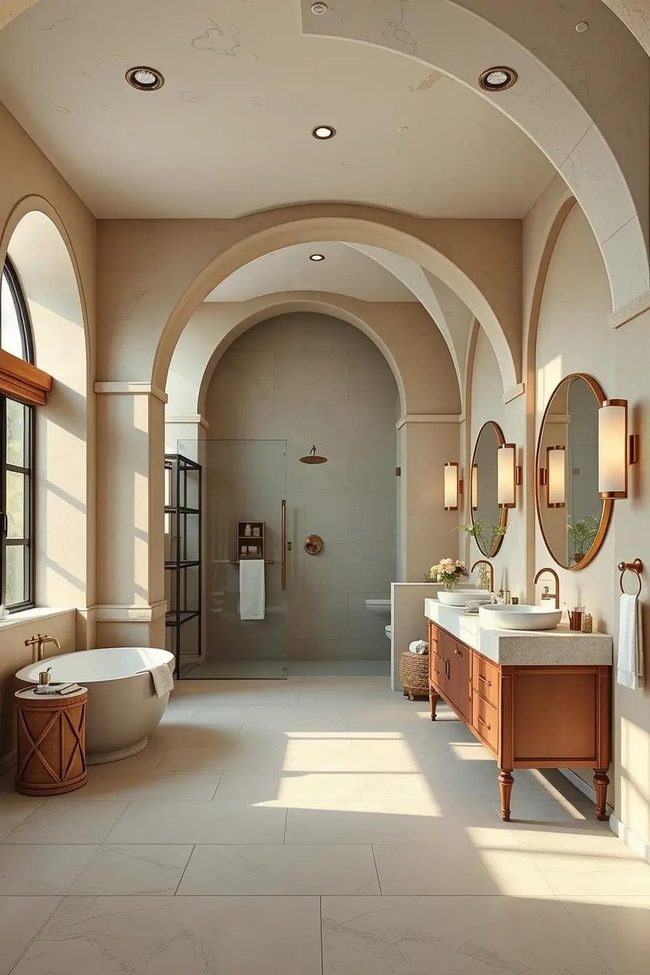
Curved archways offer a striking way to organize open bathrooms, especially when your space combines a chamber or spa area and you want privacy without blocking movement between zones.
Building arches between your shower and vanity or between your soaking tub and dressing area makes the whole room feel balanced and well-designed.
These arches don't need to be solid walls - they can be partial dividers or wide openings that simply separate one section from another.
You can build them from plaster, tile, or wood slats depending on your style, and pairing them with mirrors or bleacheding makes them even more effective.
Open bathrooms sometimes feel too empty and need better space definition, and arches solve both function and looks at the same time.
Ceiling height and wall color matter when you're planning these features.
A gentle arch works best with textured finishes like limewash or microcement, which highbleached the curved shape while keeping it understated and natural.
Jasmine Lee
Content Creator & Style Advisor
Expertise
Content Creation & Engaging Writing, Home Project Ideas & Decorating Tips, DIY Projects & Creative Solutions, Trend Spotlights & Practical Styling Advice, Easy-to-Follow Guides for Home Decor
Education
University of California, Los Angeles (UCLA)
Jasmine Lee is a content creator and style advisor at Nesthance, making home décor feel fun and effortless. With a degree in communications from UCLA, she has a knack for turning decorating ideas into easy, step-by-step guides that anyone can follow.
She loves sharing practical styling tips, creative DIY projects, and trend insights to help readers refresh their spaces without stress. Her work focuses on making design approachable and inspiring for all.
Outside of writing, Jasmine enjoys discovering new design trends, attending workshops, and curating inspiration boards to keep ideas fresh and exciting.